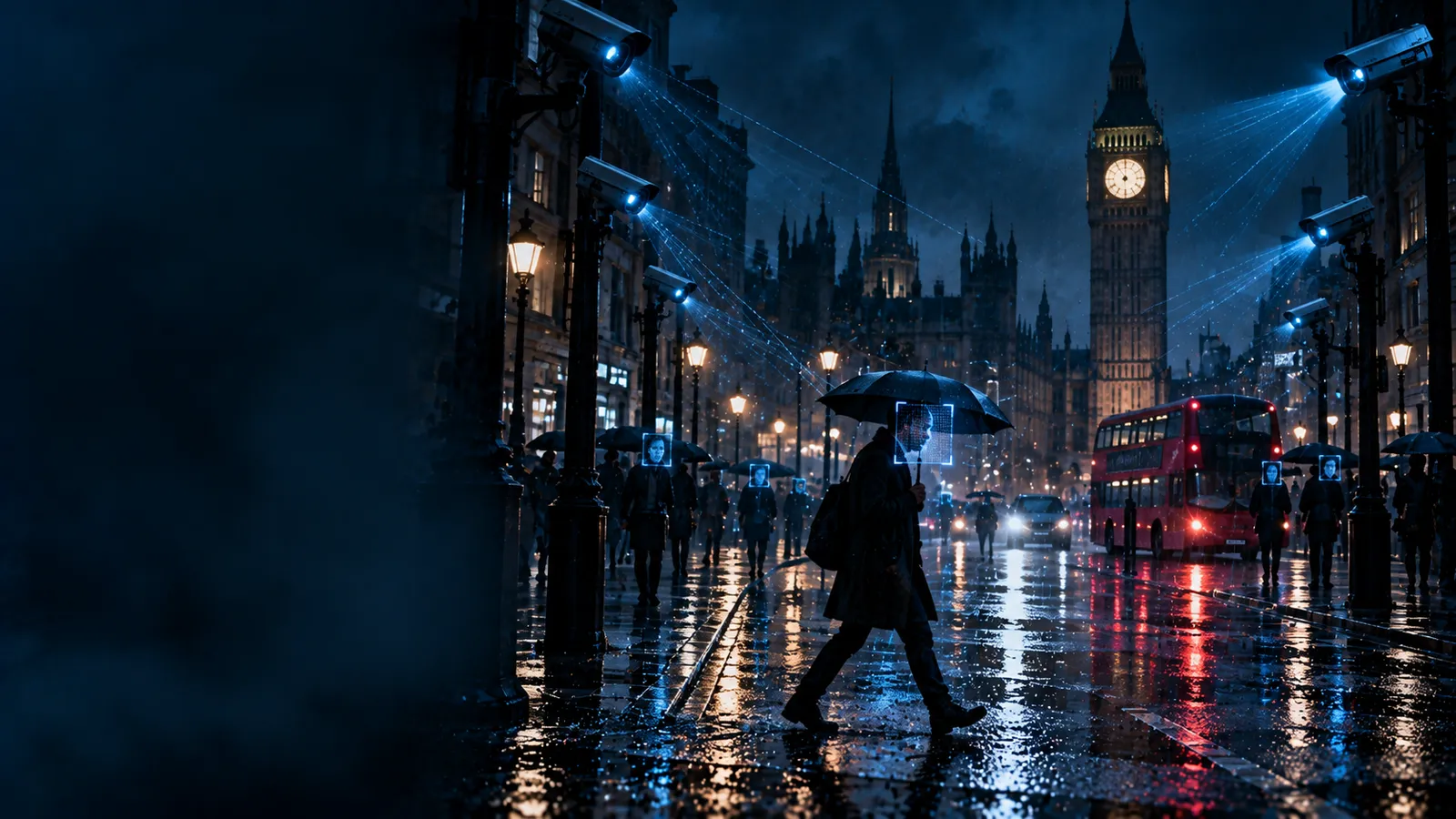
Nobody knows exactly how many CCTV cameras operate in the UK, because there is no national register. The most widely cited estimate, from the British Security Industry Association (BSIA) in 2013, is 4 to 5.9 million cameras, roughly one for every 11 to 14 people, most of them privately owned. The fastest-growing and best-documented part of the picture is police live facial recognition (LFR): London’s Metropolitan Police alone scanned more than 3.1 million faces in the year to September 2025.
Number of CCTV cameras in the UK
Records vs. estimates
UK camera totals are often quoted as if they were measured, when all of them are estimates.
| Figure | Type | Period | Source |
|---|---|---|---|
| 4 million (low), 4.9 million (medium), 5.9 million (high) CCTV cameras in the UK | Estimate | 2013 | BSIA via CCTV Surveillance, 2013 |
| One camera per 11-14 people | Estimate (derived) | 2013 | BSIA via CCTV Surveillance, 2013 |
| 3,147,436 faces scanned by Met Police LFR in 203 deployments | Police records | Sep 2024-Sep 2025 | The Register, 2025 |
| 7+ million faces scanned by police facial recognition, England and Wales | Compiled from police records | ~12 months to Dec 2025 | Big Brother Watch, 2025 |
| 13 police forces have used LFR | Government figure | as of Dec 2025 | Home Office via WiredGov, 2025 |
| 25,000+ retrospective facial recognition searches per month | Government figure | as of Dec 2025 | Home Office via WiredGov, 2025 |
The BSIA built its estimate by modeling more than 200 sectors of the economy, from shops to schools, and adding up low, medium and high figures for each. The association itself acknowledged that, with no single reliable data source, no total could be considered truly accurate (BSIA via CCTV Surveillance, 2013). The estimate is now more than a decade old and predates the boom in cheap cloud cameras and video doorbells, so the real total today is unknown. Be cautious with any higher number quoted without a method.
Who runs the cameras
The BSIA’s 2013 work concluded that private companies fund the majority of the UK’s CCTV, and that most footage used by police comes from private systems (BSIA via CCTV Surveillance, 2013). It estimated around 750,000 cameras in “sensitive” locations such as schools, health facilities and restaurants.
Operators fall into four groups:
- Businesses and private landlords run cameras in shops, offices, transport hubs and car parks. These are covered by UK GDPR and the Data Protection Act 2018, enforced by the Information Commissioner’s Office (ICO).
- Local authorities run town-center and traffic cameras and must have regard to the Surveillance Camera Code of Practice.
- Police use fixed and mobile CCTV, body-worn video, number plate recognition and, increasingly, facial recognition. They are also bound by the Code.
- Households use doorbell and home cameras. If these capture areas beyond the owner’s property, data protection law can apply, as the 2021 Fairhurst v Woodard case showed (see below).
Police live facial recognition, 2024 to 2026
The Met’s numbers
LFR compares faces passing a camera against a watchlist in real time. Between September 2024 and September 2025, the Met’s 203 deployments scanned 3,147,436 faces, generated 2,077 alerts and led to 962 arrests, mostly of people wanted by the courts (The Register, 2025). The Met reported 10 false alerts. Eight of those ten involved Black people; the force said this was not statistically significant and attributed it to deployment locations, while Big Brother Watch called it disturbing.
National rollout
| Date | Development | Source |
|---|---|---|
| Aug 13, 2025 | Home Office announces 10 LFR vans for seven forces, including Greater Manchester, West Yorkshire, Bedfordshire, Surrey/Sussex and Thames Valley/Hampshire | Government Technology, 2025 |
| 2025 | Two permanently installed Met LFR cameras in Croydon are used to inform national guidance | The Register, 2025 |
| Dec 2025 | Home Office consultation on a new legal framework and a single regulator for police biometrics (closed Feb 12, 2026) | Home Office via WiredGov, 2025 |
| Feb-Jul 2026 | British Transport Police rail trial: 18 deployments, 500,000+ faces, one alert (a false match), no arrests, about £320,000 | Biometric Update, 2026 |
| Aug 11, 2026 | LFR trial begins at Victoria Underground station, running through November 2026 | Biometric Update, 2026 |
Big Brother Watch’s per-force tally shows how unevenly the technology is used: about 3.51 million faces scanned by the Met, 1.84 million by South Wales Police and 1.18 million by Essex Police, with smaller numbers elsewhere (Big Brother Watch, 2025). These totals count scans rather than unique people, and the same person can be scanned many times.
The legal framework
No single surveillance law
The UK has no statute dedicated to CCTV or facial recognition. Instead, several layers overlap:
- The Protection of Freedoms Act 2012 requires a Surveillance Camera Code of Practice. The current version took effect on January 12, 2022 and sets 12 guiding principles. Police and local authorities must have regard to it; other operators are encouraged to adopt it voluntarily (GOV.UK, 2021).
- UK GDPR and the Data Protection Act 2018 apply to almost all CCTV that identifies people and are enforced by the ICO.
- The Human Rights Act and ECHR Article 8 are the basis of the main court challenges.
Court rulings
In August 2020, the Court of Appeal ruled in R (Bridges) v Chief Constable of South Wales Police that the force’s use of automated facial recognition was unlawful, because the legal framework left too much discretion over who could be put on watchlists and where cameras could be used (Simmons & Simmons, 2020).
Police forces responded with tighter written policies. On April 21, 2026, the High Court dismissed a challenge to the Met’s LFR policy brought by Shaun Thompson, a Black Londoner wrongly flagged in 2024, and Big Brother Watch director Silkie Carlo. The court found the policy contained “clear, interlocking and cumulative constraints.” Both claimants said they would appeal (Local Government Lawyer, 2026).
Oversight changes
The previous government’s Data Protection and Digital Information Bill would have abolished the Biometrics and Surveillance Camera Commissioner and moved some functions to the ICO, but it fell when the May 2024 general election was called (Biometric Update, 2024). The post then sat without a permanent holder for over a year until Professor William Webster took office on November 1, 2025 (Biometric Update, 2025). The Home Office consultation that ran from December 2025 to February 2026 proposes consolidating oversight under a new regulator, so the structure may change again.
Home cameras
In Fairhurst v Woodard (Oxford County Court, October 2021), a homeowner’s driveway camera and doorbell audio, which captured a neighbor’s property and conversations, were found to breach data protection law, and a harassment claim also succeeded. The court found that incidental video of the public street from the doorbell was lawful (Inforrm, 2021).
CCTV and crime
A 40-year systematic review and meta-analysis found CCTV associated with a significant but modest reduction in crime, with the largest effects in car parks and residential areas and against vehicle and property crime. Actively monitored systems performed better than passive ones (Piza et al., 2019). Cameras can help in specific settings, but sheer camera density is not a reliable proxy for safety.
What this means for you
- Under UK GDPR, you can request footage of yourself by making a subject access request to the business, council or police force that recorded you. Act quickly, because standard CCTV is typically kept only for a limited period (reporting on the London Underground LFR trial cites 31 days for regular CCTV footage, per Biometric Update, 2026).
- Camera signage usually names who runs the system, and that is who you write to.
- If you are stopped after an LFR alert, remember that alerts can be wrong, as the Met’s own false-alert figures show. Ask the officers to explain the alert, and note names, time and place in case you want to complain later.
- If you install a camera at home, point it at your own property, avoid recording audio beyond your boundary, and tell neighbors. Capturing their garden or conversations can expose you to legal claims.
- A VPN encrypts internet traffic and does nothing about cameras on the street.
- Follow the legislation, since the outcome of the Home Office consultation will decide how facial recognition is regulated for years.
Methodology
Camera totals come solely from the BSIA’s 2013 estimate, given here with its range and limitations and kept separate from figures based on records. Facial recognition figures come from police records reported by The Register (Met annual report), Big Brother Watch’s compilation of force records, a Home Office consultation announcement and Biometric Update’s reporting on the British Transport Police trial. Legal sections draw on the Surveillance Camera Code (GOV.UK) and on law firm and court reporting on the Bridges, Thompson and Carlo and Fairhurst cases.
No authoritative, current count of UK cameras exists. Commercial “cameras per city” rankings are left out because their methods are not independently verifiable. Facial recognition scan counts measure scans, not individuals, and periods differ between sources. Developments after September 2026 are not reflected.